
When Starting a Career in Tech?
Start With the Basics • Build Real Skills • Become Industry-Ready
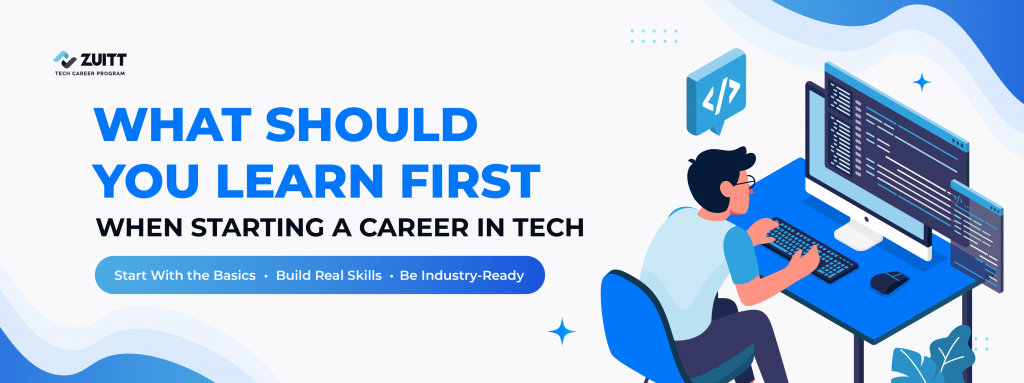
Starting a career in tech can feel exciting, but it can also be overwhelming.
Search for “how to start a career in tech,” and you’ll quickly find dozens of programming languages, technologies, career paths, and online courses. You might come across Python, JavaScript, artificial intelligence, cybersecurity, cloud computing, data science, and more.
With so many options, it’s easy to wonder: What should I actually learn first?
The good news is that you don’t need to learn everything before you can start building a career in tech.
What you need is a strong foundation, a clear learning path, and plenty of opportunities to practice what you learn.
Whether you’re completely new to coding or considering a career shift into technology, knowing where to start can make your learning journey much less overwhelming.
Start By Understanding Coding Fundamentals
Before jumping into advanced technologies, start by understanding the fundamentals of coding.
Programming is more than learning how to write lines of code. It’s about learning how to break down problems, create logical solutions, and give computers clear instructions.
As a beginner, you’ll encounter concepts such as:
- Variables
- Conditions
- Loops
- Functions
- Data structures
- Basic problem-solving
You don’t need to master everything immediately. The goal is to understand what these concepts do and how they work together.
For example, if you’re building a simple program that determines whether someone can enter an event, you might use a variable to store their age and a condition to check whether they’re old enough to enter.
Exercises like these may seem simple, but they help develop the logical thinking you’ll need as you take on more complex programming challenges.
Strong coding fundamentals become the foundation for almost everything else you’ll learn as you progress into software development.
Learn How Websites and Applications Work

For many beginners, web development is a practical starting point for learning tech skills.
Instead of trying to learn every programming language available, you can begin with the basic technologies that make websites work.
A common starting point is:
HTML → CSS → JavaScript
HTML provides the structure of a webpage.
CSS controls how that webpage looks, from its layout and spacing to its colors and visual design.
JavaScript adds functionality and allows users to interact with the webpage.
Once you understand these foundations, you can gradually move into more advanced technologies, including frameworks, databases, APIs, and back-end development.
This can eventually lead to a Full-Stack Web Development Path, where you learn how different parts of a web application work together.
The important thing is not to rush.
You don’t need to know every framework or programming language on your first day. Start with the fundamentals, understand how they work, and build from there.
Practice Hands-on Learning and Build Projects

One of the biggest challenges beginners face when learning coding is mistaking consuming information for actually learning.
You can watch hours of tutorials, read programming articles, and follow coding videos without ever feeling confident enough to build something yourself.
That’s why Hands-on Learning is so important.
Once you’ve learned the basics, start building small projects.
You could create:
- A personal webpage
- A simple landing page
- A portfolio website
- An interactive web application
- A basic productivity tool
Your first project doesn’t need to be impressive.
What matters is that you’re applying what you’ve learned.
When something doesn’t work, figure out why. When you encounter an error, try to understand it. When you don’t know how to build something, research possible solutions and experiment.
This process helps turn theoretical knowledge into practical skills.
Being Industry-Ready isn’t about knowing every technology available. It’s about being able to take what you’ve learned and use it to solve problems.
Learn the Tools Developers Actually Use

Coding is only one part of becoming a developer.
As you progress, you’ll also need to become familiar with the tools developers use to write, manage, test, and collaborate on projects.
Some examples include:
- Code editors
- Git and GitHub
- Browser developer tools
- Command-line tools
- Debugging tools
You don’t have to become an expert in all of them immediately.
Instead, learn what each tool does and gradually become comfortable using them as you work on projects.
For example, Git helps developers keep track of changes to their code, while GitHub allows developers to store and collaborate on projects.
Learning these tools alongside programming can help you become more comfortable with the workflows used in actual development environments.
This is an important part of Job-Ready Tech Training because becoming prepared for a tech career involves more than simply knowing programming syntax.
You also need to know how to apply your skills in a development environment.
Develop Problem-Solving Skills Along the Way
Learning how to code isn’t simply about memorizing commands.
One of the most important skills you’ll develop as a programmer is problem-solving.
When you’re given a coding challenge, you won’t always know the answer immediately. That’s normal.
Instead of immediately looking for a solution, try breaking the problem into smaller pieces.
Ask yourself:
What am I trying to accomplish?
What information do I already have?
What steps do I need to take?
How can I test my solution?
If something goes wrong, what could be causing it?
Learning how to approach problems this way will help you become more independent as you progress.
It’s also especially important as AI becomes a bigger part of software development.
Tools like ChatGPT can help explain concepts, provide suggestions, and assist with debugging. But they shouldn’t replace your ability to think through a problem.
The goal isn’t just to get working code.
The goal is to understand why it works.
You Don’t Have to Figure Everything Out Alone

One of the hardest parts of starting a career in tech isn’t necessarily learning how to code.
Sometimes, it’s figuring out what to learn next.
Beginners can easily get stuck jumping between tutorials, programming languages, and online resources. You might spend weeks learning something only to discover that you weren’t ready for it yet.
This is where having a structured learning environment can make a difference.
An Instructor-Led Coding Program can give beginners a clear curriculum and learning progression. Instead of constantly asking yourself what to study next, you have a defined path to follow.
Guided Tech Mentorship can also provide support when you’re struggling with a concept, debugging a project, or simply unsure whether you’re progressing in the right direction.
The goal of guidance isn’t to remove the challenges of learning.
It’s to make sure you don’t have to face those challenges completely alone.
With the right combination of structured lessons, Hands-on Learning, and support, beginners can focus more of their energy on actually developing their skills.
See Where Learning Tech Can Take You

Starting something new can feel uncertain, especially when you’re coming from a non-tech background. Sometimes, hearing from people who have already taken that first step can make the journey feel a little more achievable.
Hear directly from Zuitt students and graduates about their experiences learning tech, building their skills, and working toward their career goals.
Watch their stories and see what their tech journey looks like:
Watch Zuitt Student Testimonials on YouTube
Their experiences are a reminder that you don’t have to start as an expert. With Hands-on Learning, the right guidance, and consistent effort, you can continue building your skills and move closer to becoming Industry-Ready.
Start Your Tech Career with the Right Foundation
You don’t need to know everything before starting a career in tech.
You don’t need to master multiple programming languages.
And you don’t need to have your entire career figured out before writing your first line of code.
You simply need to know where to start.
Begin with the fundamentals. Learn how websites and applications work. Practice by building projects. Get comfortable with common development tools. Most importantly, develop the ability to solve problems and learn from your mistakes.
From there, you can continue expanding your skills and work toward Complete Full-Stack Development and other areas of technology that match your career goals.
If you’re looking for a structured way to begin, Zuitt’s Tech Career Program is designed to help beginners develop practical coding skills through an Instructor-Led Coding Program, Hands-on Learning, and Guided Tech Mentorship.
You don’t have to figure out your entire tech career before taking your first step.
With the right guidance, consistent practice, and a commitment to learning, you can build your skills one step at a time and work toward becoming Industry-Ready.
Your tech career doesn’t have to start with knowing everything.
It can start with simply deciding to learn.